“You can’t go back and change the beginning, but you can start where you are and change the ending.” (C.S. Lewis)
Divorce is traumatic, to the extent that it’s widely considered to be the second most stressful life event (behind only the death of a spouse, and ahead of marital separation and going to jail!).
But if you’ve come to the conclusion that your marriage is so unhappy or toxic that you have no alternative but to put an end to it, you’ll need to know how to go about obtaining a divorce, and what your legal rights are.
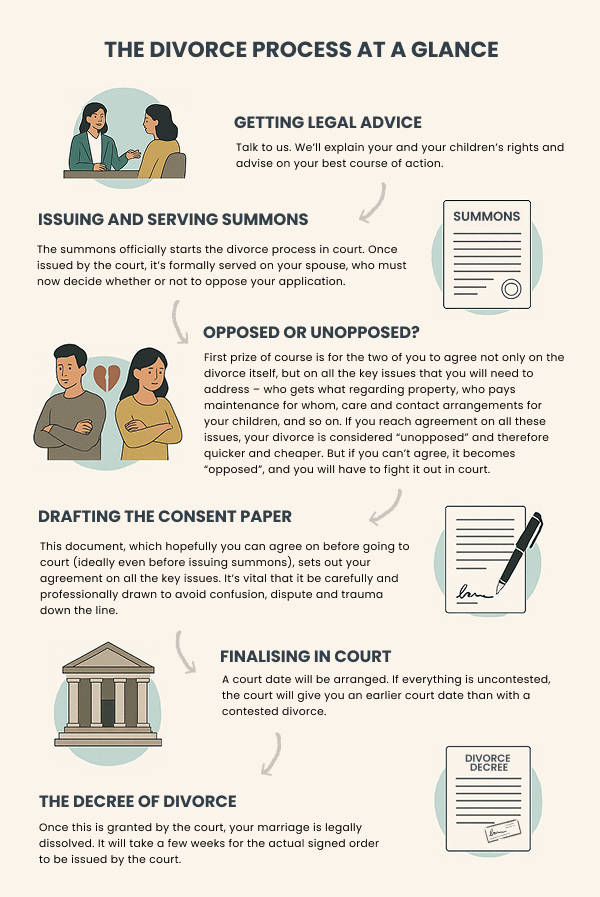
The whole process can feel overwhelming, but it needn’t be. Here’s a clear, simplified overview, followed by a Q & A section to address some of the concerns and queries you may be grappling with.
9 common questions answered
Here are some of the most commonly asked questions. Let us know if you have any others!
Do I have grounds for divorce? Our law has since 1979 had a “no fault” concept, so all you must show is that your marriage has broken down irretrievably, with no reasonable possibility of reconciliation. Mental illness or coma are other grounds for divorce but fortunately they rarely apply.
How long does it all take? In an uncontested divorce (depending on how quickly you reach agreement, how busy the courts are, and a myriad of other factors) you should work on between two and three months. A complex contested divorce on the other hand could take years, particularly when fought bitterly through all the appeal courts.
How are our children protected? Parenting plans, care and contact, maintenance and schooling arrangements can and should be settled by agreement if possible. Otherwise, the Family Advocate’s office can help – it’s a free and impartial service, tasked with protecting the welfare of children through investigation, mediation, reporting and making recommendations to the court. If you are still deadlocked and leave it to the court to decide one way or the other, bear in mind that our courts always put your children’s best interests first – no exceptions.
What about maintenance for me and our children? Both of you must contribute to the reasonable financial needs of your children based on your respective financial positions, and child maintenance orders in favour of the parent with primary care (“custody” in the old terminology) are commonly granted. Orders for spousal maintenance (“alimony” in American legalese) are less common and depend on a host of factors. You may also be able to claim interim maintenance pending the divorce.
How much will this cost me? We can give you an idea of the likely cost based on whether or not the divorce is contested and the complexity of the issues involved. A simple, uncontested divorce will always be the least costly option. If the divorce is contested and you can’t afford to pay legal fees, you may be entitled to a contribution to your legal costs from your spouse. Sometimes, when granting a disputed divorce, a court will order one of you to pay the other’s costs, but the general rule is that each of you will pay your own costs. And of course you can always agree between yourselves who pays what costs.
What assets will I get? What you are legally entitled to depends largely on whether you are married in community of property or out of community of property (with or without accrual), and on what your ante-nuptial contract (if you made one) says. The court also has wide discretion to order a redistribution of assets in your favour in appropriate cases – and of course you can agree between the two of you to divide assets any way you want.
What if there’s domestic abuse? We’ll help you get an urgent protection order to keep you and your children safe.
I really don’t want this to go to trial, how can I avoid that? Mediation is often an effective way to help parties reach an agreement on contentious issues. The reality is that most divorce disputes are eventually settled by agreement – if not upfront, then “on the steps of the court”, or perhaps only after battle has begun and everyone can see which way the wind’s blowing.
How does Home Affairs know I’m divorced? We’ll help you send a certified copy of the divorce decree to Home Affairs to update your marital status on the National Population Register.
Talk to us if you’re considering divorce – or even if you just want to understand your options.
Disclaimer: The information provided herein should not be used or relied on as professional advice. No liability can be accepted for any errors or omissions nor for any loss or damage arising from reliance upon any information herein. Always contact us for specific and detailed advice.
We use cookies on our website to give you the most relevant experience by remembering your preferences and repeat visits. By clicking “Accept All”, you consent to the use of ALL the cookies. However, you may visit "Cookie Settings" to provide a controlled consent.
This website uses cookies to improve your experience while you navigate through the website. Out of these, the cookies that are categorized as necessary are stored on your browser as they are essential for the working of basic functionalities of the website. We also use third-party cookies that help us analyze and understand how you use this website. These cookies will be stored in your browser only with your consent. You also have the option to opt-out of these cookies. But opting out of some of these cookies may affect your browsing experience.
Necessary cookies are absolutely essential for the website to function properly. These cookies ensure basic functionalities and security features of the website, anonymously.
Cookie
Duration
Description
cookielawinfo-checkbox-analytics
11 months
This cookie is set by GDPR Cookie Consent plugin. The cookie is used to store the user consent for the cookies in the category "Analytics".
cookielawinfo-checkbox-functional
11 months
The cookie is set by GDPR cookie consent to record the user consent for the cookies in the category "Functional".
cookielawinfo-checkbox-necessary
11 months
This cookie is set by GDPR Cookie Consent plugin. The cookies is used to store the user consent for the cookies in the category "Necessary".
cookielawinfo-checkbox-others
11 months
This cookie is set by GDPR Cookie Consent plugin. The cookie is used to store the user consent for the cookies in the category "Other.
cookielawinfo-checkbox-performance
11 months
This cookie is set by GDPR Cookie Consent plugin. The cookie is used to store the user consent for the cookies in the category "Performance".
viewed_cookie_policy
11 months
The cookie is set by the GDPR Cookie Consent plugin and is used to store whether or not user has consented to the use of cookies. It does not store any personal data.
Functional cookies help to perform certain functionalities like sharing the content of the website on social media platforms, collect feedbacks, and other third-party features.
Performance cookies are used to understand and analyze the key performance indexes of the website which helps in delivering a better user experience for the visitors.
Analytical cookies are used to understand how visitors interact with the website. These cookies help provide information on metrics the number of visitors, bounce rate, traffic source, etc.
Advertisement cookies are used to provide visitors with relevant ads and marketing campaigns. These cookies track visitors across websites and collect information to provide customized ads.



Recent Comments